


Analysis Region: Daegu Metropolitan City and Daegu-Gyeongbuk New Airport Economic Zone
Key Areas: Gunwi New Airport Planned Zone, Daegu Downtown, Gumi Industrial Zone, Chilgok Logistics Zone, Central-Western Gyeongbuk Industrial Belt
Agenda: Is the new airport functioning as an economic zone that reshapes logistics, industry, corporate locations, employment, and exports, going beyond the construction of runways and transportation networks?
Golden Time Type: Infrastructure Lock-In + Spatial Transformation
Reference Date: August 28, 2026
Version: Regional AX Golden Time Intelligence v3.2
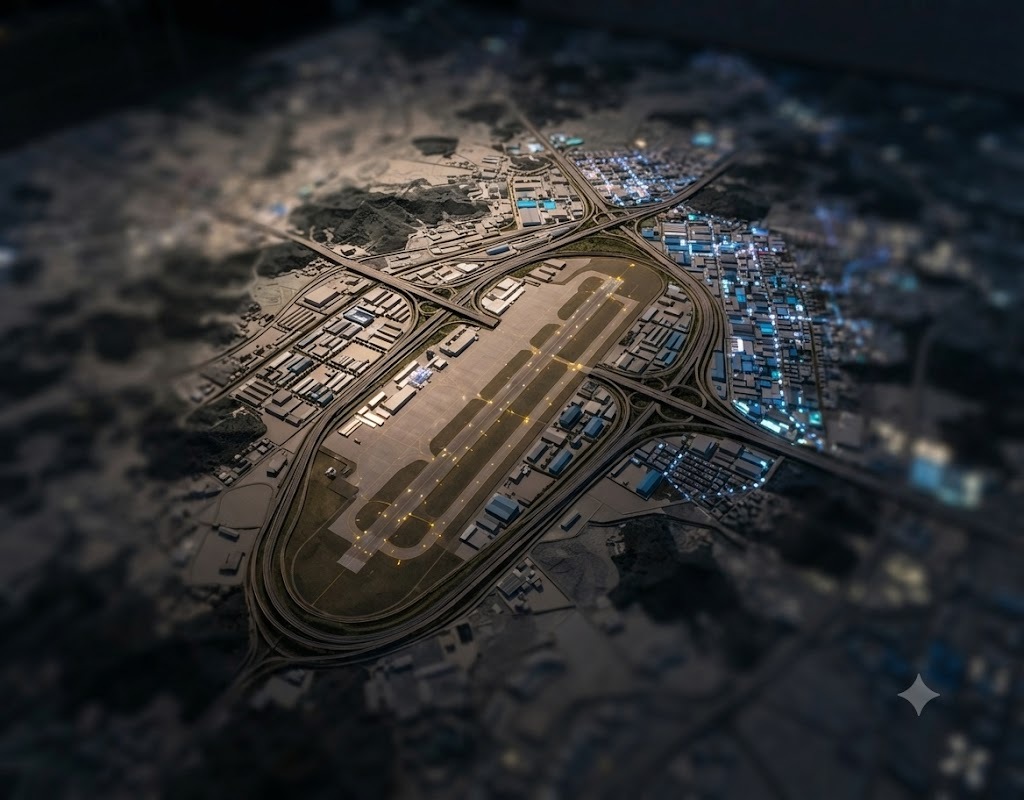
In December 2025, the Ministry of Land, Infrastructure and Transport announced the basic plan for the Daegu-Gyeongbuk Integrated New Airport civilian airport, worth approximately 2.7 trillion won. In August 2026, a metropolitan railway connecting Daegu, Donggumi, the Gunwi New Airport, and Uiseong—a length of 70.06 km and a scale of 3.1813 trillion won—passed the preliminary feasibility study. While the airport and access railway have secured the status of national plans, funding for the military airport relocation, companies in the hinterland industrial complex, and air cargo routes have not yet reached the final stage. If the airport and railway proceed without accompanying industrial and logistics demand over the next two to three years, the new airport will be reduced to a large-scale transportation facility rather than an economic zone transformation project. Verdict: The success or failure of the new airport depends not on whether construction takes place, but on how much industrial demand can be secured prior to opening.
Air export cargo volume in the Daegu-Gyeongbuk region was analyzed to be approximately 57,308 tons, accounting for 8.7% of domestic air exports, while Gumi accounted for 93% of Gyeongbuk's air export value and 48% of its import and export cargo volume in 2022. Although potential demand exists for the new airport to handle, a significant volume is already incorporated into the supply chain utilizing Incheon Airport. Unless regional cargo volume secures competitiveness over Incheon in terms of airline routes, flight frequency, freight rates, and customs clearance times, it will not shift to the regional airport. Unless prior agreements are formed among shippers, airlines, and logistics companies over the next two to three years, existing logistics routes will be maintained even after the airport opens. Verdict: The existence of regional cargo has been confirmed, but a transition to cargo at the new airport has not yet been confirmed.
The master plan for the civilian airport allocates a 3,500m runway and approximately 123,650㎡ of passenger terminal and cargo facilities to the area encompassing Sobo-myeon in Gunwi-gun and Bian-myeon in Uiseong-gun, projecting approximately 12.65 million passengers and 230,000 tons of cargo by 2060. This structure expands the site by more than seven times and the passenger terminal by more than four times compared to the existing Daegu Airport. However, the target demand is a long-term forecast rather than a confirmed volume at the time of opening, and performance figures for securing international and cargo routes have not been disclosed separately. If a route infrastructure is not established over the next two to three years, a gap between the large-scale facilities and actual throughput will accumulate from the initial opening. Assessment: While the physical scale of the airport has been finalized, its economic scale still depends on demand forecasts.
While a basic plan securing approximately 2.7 trillion won in state funding has been secured for the civilian airport, the relocation of the military airport is being pursued through a donation-for-transfer method worth approximately 11.5 trillion won. The 279.5 billion won from the Public Funds Management Fund, intended for land compensation and other expenses in 2026, has not been reflected in the government budget, and the financing structure, which relies on development profits from the existing K-2 site, has not been finalized. In the integrated civilian-military construction project, delays in the military airport schedule will lead to a chain reaction of adjustments to the civilian airport, access transportation, and hinterland city schedules. With annual cost increases of 300 to 400 billion won due to inflation being discussed, a delay of two to three years weakens the project's feasibility itself. Verdict: The biggest bottleneck currently is not the airport design, but the upfront funding for the military airport relocation.
The Daegu-Gyeongbuk Metropolitan Railway has passed the preliminary feasibility study with a plan to connect West Daegu to Donggumi, the new Gunwi Airport, and Uiseong, and to deploy trains capable of speeds up to 180 km/h. Analysis indicates that travel time from West Daegu to the new airport will be reduced from approximately 62 minutes by car to about 25 minutes by train. While passenger accessibility will be significantly improved, the alignment of the railway's construction and opening dates with the new airport's opening date has not yet been confirmed. If design and financing procedures are delayed for two to three years, an accessibility gap will occur between the airport's opening and the metropolitan railway's launch. Verdict: The metropolitan railway has entered the role of a fundamental axis of the economic zone, but simultaneous opening remains unconfirmed.
Based on projected passenger demand of approximately 12.65 million and cargo demand of approximately 230,000 tons by 2060, this indicates the long-term operational scale of a passenger and cargo complex airport. Structurally, the new airport is designed to expand international flight and cargo functions beyond a mere relocation of the existing Daegu Airport. However, the capacity of the cargo terminal alone does not automatically facilitate the collection, customs clearance, bonded warehousing, cold chain operations, and transshipment of high-value-added cargo. If industry-specific cargo operators are not finalized over the next two to three years, the industrial airport function will remain separate, even if passenger numbers increase. Verdict: The Daegu-Gyeongbuk New Airport was designed as a complex airport but has not been verified as an industrial airport.
Currently, Daegu Airport is a passenger-focused airport, and a significant portion of air exports from Daegu and Gyeongbuk departs from Incheon Airport after being transported by land. While the new airport proposes a structure for handling regional cargo locally, the frequency and unit prices of international cargo routes compete with the agglomeration effects of Incheon Airport. With regional cargo volumes dispersed, there may be insufficient minimum demand for airlines to establish and maintain regular cargo routes. If cargo from Gumi, Daegu, and Gyeongbuk cannot be consolidated into a single collection contract within two to three years, the new airport will be unable to secure cargo routes despite possessing regional cargo. Verdict: The gap in air logistics lies in cargo collection capacity rather than cargo generation volume.
Analysis shows that out of Gumi's total exports of $29.8 billion in 2022, approximately $15.8 billion consisted of electronics, IT, and optical products highly dependent on air transport, and Gumi accounted for 93% of Gyeongbuk's air exports. Gumi is the industrial city closer to the new airport's direct cargo base than Daegu. However, the volume of cargo currently handled by Gumi companies at Incheon Airport that can be transferred to the new airport, as well as the conditions for this transfer, have not been disclosed. Unless demand from shippers stabilizes over the next two to three years, Gumi will remain a city utilizing the existing Incheon Airport rather than a supporting industrial city for the new airport. Verdict: The first anchor for the new airport's air logistics is the Gumi Industrial Complex, not Gunwi.
The Gumi-Gunwi Expressway is currently undergoing basic planning and feasibility studies, while the Daegu-Gyeongbuk Metropolitan Railway directly connects Donggumi Station with the new airport. Although the travel time between Gumi and the airport is being shortened, cargo will be transported via dedicated roads, trucks, logistics centers, and customs facilities rather than passenger railways. Integrated results regarding truck travel times, transportation costs by industrial complex origin, and nighttime logistics operations have not been confirmed. If the cargo access network lags behind the passenger access network over the next two to three years, Gumi's potential cargo will maintain the existing Incheon route. Verdict: Railway evidence for the Gumi-New Airport connection is ahead, while logistics evidence lags behind.
Daegu City has envisioned the Gunwi Advanced Industrial Complex in Sobo-myeon, near the new airport, with a scale of approximately 5 to 6.3 million square meters. The project cost is being discussed at around 1.5 trillion won, up from an initial estimate of about 1.2 trillion won. While a structure has been established to secure much-needed industrial land behind the new airport, as of 2026, the project is still in the feasibility study stage, and companies committed to relocating have not been disclosed. Compared to the initial schedule of groundbreaking in 2027 and completion in 2030, the time required to attract companies and finalize infrastructure has shortened. Verdict: Although the Gunwi Advanced Industrial Complex is a core space within the airport economic zone, it is currently in the stage where development plans, rather than actual companies, have moved in.
ABB, semiconductors, UAM, and mobility were proposed as target industries for the Gunwi Advanced Industrial Complex, and ripple effects were announced, including 37.3 trillion won in production inducement and 153,000 jobs. These figures represent projected effects based on an input-output model and are distinct from actual investment contracts, permanent employment, and export values. The locational competitiveness of individual companies, including electricity, water, labor, settlement, and air logistics costs, has not been publicly verified. If anchor companies are not finalized over the next two to three years, these ripple effects will remain merely expectations for land development. Verdict: While the Gunwi industrial map is presented in terms of area, the corporate map remains blank.
Daegu is fostering future mobility, robotics, medical, semiconductors, and ABB as its D5 industries, and the new airport has been presented as infrastructure to connect these industries to overseas markets. While a structure enabling the division of labor—dividing R&D in downtown Daegu, production spaces in Gunwi, and logistics at the new airport—has become possible, plans for the relocation of supply chains by individual companies have not been confirmed. Unless Daegu research institutions and downtown companies expand into production bases in Gunwi, the airport and existing industries will be spatially separated. If corporate-level connections between production, research, and logistics do not emerge over the next two to three years, the new airport will remain merely an external condition for the D5 industries. Verdict: The new airport was included as a component of Daegu's future industries but was not incorporated as an internal facility within the industrial value chain.
Daegu's downtown industrial complexes lack large-scale new investment sites, while Gunwi possesses extensive available land near the new airport. The axis of industrial land supply is expanding from the southwestern Dalseong area to the northern Gunwi area. However, Gunwi's low resident population, difficulty in securing an industrial workforce, and accessibility to housing, education, and medical services represent a proven gap in attracting large-scale corporations. If living infrastructure develops later than industrial land over the next two to three years, companies will fail to recruit production personnel even if they secure land. Verdict: While Daegu's industrial space is expanding toward Gunwi, the labor market and living spheres have not shifted at the same pace.
Gyeongbuk possesses a multi-core industrial structure encompassing electronics and semiconductors in Gumi, steel and secondary batteries in Pohang, automotive parts in Gyeongsan, biotechnology in Andong, and agri-food in Uiseong. The Gyeongbuk Provincial Government has proposed a "Hexaport" connecting six zones: airports and logistics, education and mobility, advanced smart technology, life sciences and biotechnology, clean and forestry industries, and marine and energy. However, no common performance indicators linking airport users, projected cargo volumes, and road access times by zone have been identified. If only zone-specific industrial plans are pursued in parallel for the next two to three years, the airport will serve as a justification for additional development in each region rather than acting as a hub connecting Gyeongbuk's industries. Verdict: While the Gyeongbuk industrial zone possesses a multi-core structure, the airport-centered division of labor is still in the planning stage.
Pohang's steel and secondary battery industries rely heavily on maritime and land logistics, while Gumi's electronics and optics industries are highly suitable for air logistics. Even within the same new airport economic zone, dependence on the airport varies by industry. Since regional logistics classifications reflecting item weight, price, delivery time, and storage conditions have not been disclosed, it is being presented as if all industries benefit equally from the airport. If economic feasibility by industry is not differentiated over the next two to three years, the priority of supporting businesses will be determined by the scale of facilities. Assessment: Although the scope of the new airport economic zone is broad, the industries that directly benefit are limited.
The passing of the preliminary feasibility study for the Daegu-Gyeongbuk Metropolitan Railway and the promotion of the Gumi-Gunwi Expressway form an inland axis connecting the new airport to Daegu, Gumi, and Uiseong. Gyeongbuk Province has also proposed a K-Land Bridge concept linking Yeongilman Port, the new airport, and Saemangeum Port. However, actual transshipment times, freight rates, operators, and demand by product category between ports, inland areas, and air travel have not been verified. Without demonstration of multimodal transport for two to three years, the connection between ports and airports will remain merely on the map. Verdict: While transportation networks are becoming more diversified, multimodal logistics products do not yet exist.
The metropolitan railway project aims to reduce passenger access to the new airport to the 30-minute range, while the expressway handles industrial logistics and regional access. Although the functions of the two transportation networks are complementary, there is no definitive evidence that the construction and completion schedules will coincide with the airport's opening date. If either axis is delayed, the airport's initial demand zone will shrink. If a simultaneous opening schedule is not fixed over the next two to three years, a period of underutilization will occur prior to the completion of the transportation network. Assessment: The time risk for the airport economic zone is greater from the mismatch in opening dates than from delays in individual projects.
The institutional readiness level for the airport and railway has risen with the approval of the master plan for the civilian airport and the preliminary feasibility study for the metropolitan railway. On the other hand, funding for the military airport, the conversion of cargo to Gumi, tenant companies in the Gunwi Advanced Industrial Complex, and international cargo routes have not yet been finalized. The pace of preparation for the physical infrastructure and the economic operational infrastructure is currently disconnected. If this gap persists for the next two to three years, the progress rate of airport construction and the rate of economic zone formation will move in opposite directions. Assessment: The overall readiness level is at the 'transportation plan finalized – industrial operations unfinalized' stage.
The approximately 57,000 tons of air exports from Daegu and Gyeongbuk, along with Gumi's high dependence on air exports, demonstrate potential cargo volume. However, cargo agreements and regular routes between airlines, shippers, and logistics companies were not confirmed during the initial opening period. Cargo facilities were planned without potential demand converting into confirmed demand. Unless a pre-collection system is established within two to three years, Incheon Airport's existing network will continue to maintain its advantage. Assessment: While a cargo volume base exists, the level of readiness for the air logistics business is low.
The Gunwi Advanced Industrial Complex, Uiseong Airport New City, Gumi Aerospace Electronics Cluster, and Gyeongbuk Hexaport are being pursued in parallel. While airport-linked industrial plans have spread to various regions, corporate investment and employment outcomes have not yet been confirmed. A joint placement system designed to coordinate overlapping business sectors and competition among tenant companies has also not been disclosed. If development plans by local governments proceed independently over the next two to three years, multiple hinterland development projects will be formed rather than a single economic zone. Verdict: Airport-linked industries have expanded in the plans but have not expanded in the market.
The metropolitan railway is a plan to connect Daegu, Donggumi, Gunwi, and Uiseong along a single transportation axis and reduce the travel time between West Daegu and the new airport to approximately 25 minutes. While the time barrier for passenger travel is lowered, plans for residential, commuting, educational, and medical services in station areas, as well as movement plans for workers in industrial complexes, have not been confirmed. The final transportation segment between the railway station and the industrial complex also remains to be completed. If the deployment of living services is delayed for two to three years, the metropolitan railway will be limited to serving as an airport access line. Verdict: The framework of the transportation living zone has been formed, but the commuting and residential living zones remain unconfirmed.
Although the master plan for the civilian airport has been announced, funding for the military airport relocation has not been finalized, and the Gunwi Advanced Industrial Complex is currently in the feasibility study stage. The structure is such that the airport, industrial complex, railway, and expressway are being pursued through separate administrative procedures and funding structures. If funding for the military airport and companies in the hinterland industrial complex are not secured over the next two to three years, the target of opening by 2030 and the schedule for developing the economic zone will be simultaneously jeopardized. Verdict: The Golden Time is not after groundbreaking, but the next 18 months during which funding, companies, and cargo volume are simultaneously finalized.
The military airport relocation project is structured as a donation-to-transfer deal worth approximately 11.5 trillion won, with the development value of the existing K-2 site serving as the basis for financing. As the project is delayed, construction and financing costs increase, while development profits from the vacated site become exposed to fluctuations in the real estate market. If the financing structure is not stabilized over the next two to three years, rising costs and declining profitability will occur simultaneously. Assessment: The first irreversible risk is not construction delay, but the self-weakening of the financial structure.
The logistics networks of Gumi companies at Incheon Airport and airline routes constitute a long-standing business relationship. Without cargo transfer agreements prior to the opening of the new airport, companies will not relocate to the new airport while bearing supply chain risks. After the opening, low flight frequency creates low demand, and a pathway is formed where low demand, in turn, hinders route expansion. Assessment: The second irreversible risk is underutilization lock-in, which prevents the existing logistics network from being restored even after the airport is completed.
Corresponding axis | 2026~2028 Execute compression | Judgment indicators |
|---|---|---|
| Integrated Critical Path | Unification of schedules for civil aviation, military airports, railways, roads, and industrial complexes | Delay in simultaneous opening months |
| Military airport funding | Scenarios for Public Funds, State Finance, and Former Site Development Revenue Confirmed | Advance funding confirmation rate |
| Gumi Anchor Cargo | Verification of Incheon–New Airport Conversion Conditions by Major Shipper | Pre-agreed cargo volume |
| Securing air routes | Joint route design by shippers, airlines, and logistics companies | Regular cargo route contract |
| Gunwi Anchor Company | Cost-based investment commitment for electricity, water, labor, and logistics | Confirmed investment amount and employment |
| Industrial division of labor | Classification of Daegu Research, Gumi Production, Gunwi Expansion, and Uiseong Logistics | Ratio of overlapping and joint projects |
| AX Logistics Twin | Real-time simulation of items, freight, customs clearance, routes, and cargo volume | Break-even volume by route |
| Economic Sphere Outcome | Separate tracking of facility progress and corporate, logistics, and employment performance | Regional air cargo conversion rate |
The Daegu-Gyeongbuk New Airport is not yet a new industrial map, but a transportation infrastructure capable of drawing a new industrial map.
The airport economic zone is established not by the scale of facilities, but at the point when cargo from Gumi, businesses from Gunwi, research and development in Daegu, and logistics in Uiseong operate as a single trading network.
Currently, the most advanced aspect is transportation planning, while the most lagging is the confirmation of funding, companies, and air routes.
Final grade: RED–ORANGE — Infrastructure Commitment + Unsecured Economic Operating System
Evaluation Area | score | verdict |
|---|---|---|
| Civil airport plan finalized | 82 | Notice of Basic Plan |
| Military airport financial stability | 27 | Advance funding undetermined |
| Metropolitan railway readiness | 72 | Passed preliminary feasibility study |
| Road logistics network readiness | 48 | Planning and feasibility stage |
| Potential Air Cargo | 74 | Demand centered in Gumi |
| Freight Routes and Collection Systems | 34 | Lack of Contract Evidence |
| Gunwi Advanced Industrial Complex | 43 | Feasibility review stage |
| Securing Anchor Companies | 28 | Lack of public investment commitment |
| Division of functions between regions | 39 | Coexistence of individual development plans |
| Schedule consistency | 35 | Business-specific time lag risk |
| Overall score | 48/100 | RED–ORANGE |
Golden Time Window: 12~18 months
Evidence Sources
- Ministry of Land, Infrastructure and Transport Daegu-Gyeongbuk Integrated New Airport Civilian Airport Master Plan
- Daegu-Gyeongbuk Metropolitan Railway Preliminary Feasibility Study Passed
- Military airport relocation funding and 2026 project delay
- Daegu-Gyeongbuk New Airport Project Costs and Delay Costs
- Gyeongbuk New Airport Scale and Metropolitan Transportation Network Plan
- Daegu-Gyeongbuk Air Cargo and Gumi Industrial Complex Cargo Volume
- Dependence on Gumi aviation exports and new airport connectivity
- Gunwi Advanced Industrial Complex Development Plan
- Uiseong Airport New Town, Logistics, and Transportation Infrastructure Plan
Structural Insight — Airport economic zones are not formed centered around airports
Conventional airport development places the airport at the center and arranges roads, railways, and industrial complexes radially. In the Daegu-Gyeongbuk region, the actual center of air cargo is located in the existing Gumi Industrial Complex, not in Gunwi or Uiseong, the planned site for the new airport. Industry and cargo existed prior to the airport, and the new airport is a late-developing infrastructure designed to enter that supply chain.
In this structure, an economic zone is formed even without companies relocating to the vicinity of the airport. A decentralized airport economic zone operates when existing production plants in Gumi utilize the new airport routes, research and development in Daegu connects with production spaces in Gunwi, and logistics facilities in Uiseong collect cargo. Conversely, even if industrial complexes and a new city are constructed in Gunwi, if cargo volumes from existing industrial cities do not shift, development around the airport and the aviation industry remain separate.
Therefore, the industrial map of the Daegu-Gyeongbuk New Airport is not a concentric circle spreading outward from the airport, but a network where the existing functions of Gumi, Daegu, Gunwi, and Uiseong converge toward the airport. Structural Assessment: The starting point of the new airport economic zone is not the airport site, but the change in logistics routes for Gumi shippers.
Version | Date | Changes |
|---|---|---|
| v1.0 | 2026.08.28 | Analysis of Civil Airport, Military Airport, and Air Logistics Infrastructure |
| v2.0 | 2026.08.28 | Reflecting connectivity between Gumi Cargo, Gunwi Advanced Industrial Complex, and Gyeongbuk Industrial Zone |
| v3.0 | 2026.08.28 | Passage of preliminary feasibility study for metropolitan railway and determination of irreversibility regarding funding and schedule |
| v3.2 | 2026.08.28 | Evidence–Structural Change–GAP–Time Risk–Determination System Confirmation |
